
This guidance is for kitchen managers, head chefs and catering staff responsible for preparing and serving vegetarian and vegan dishes alongside non-vegetarian menus. None of it requires specialist knowledge — just clear processes applied consistently.
Guidance
Kitchen practices for vegetarian and vegan dishes
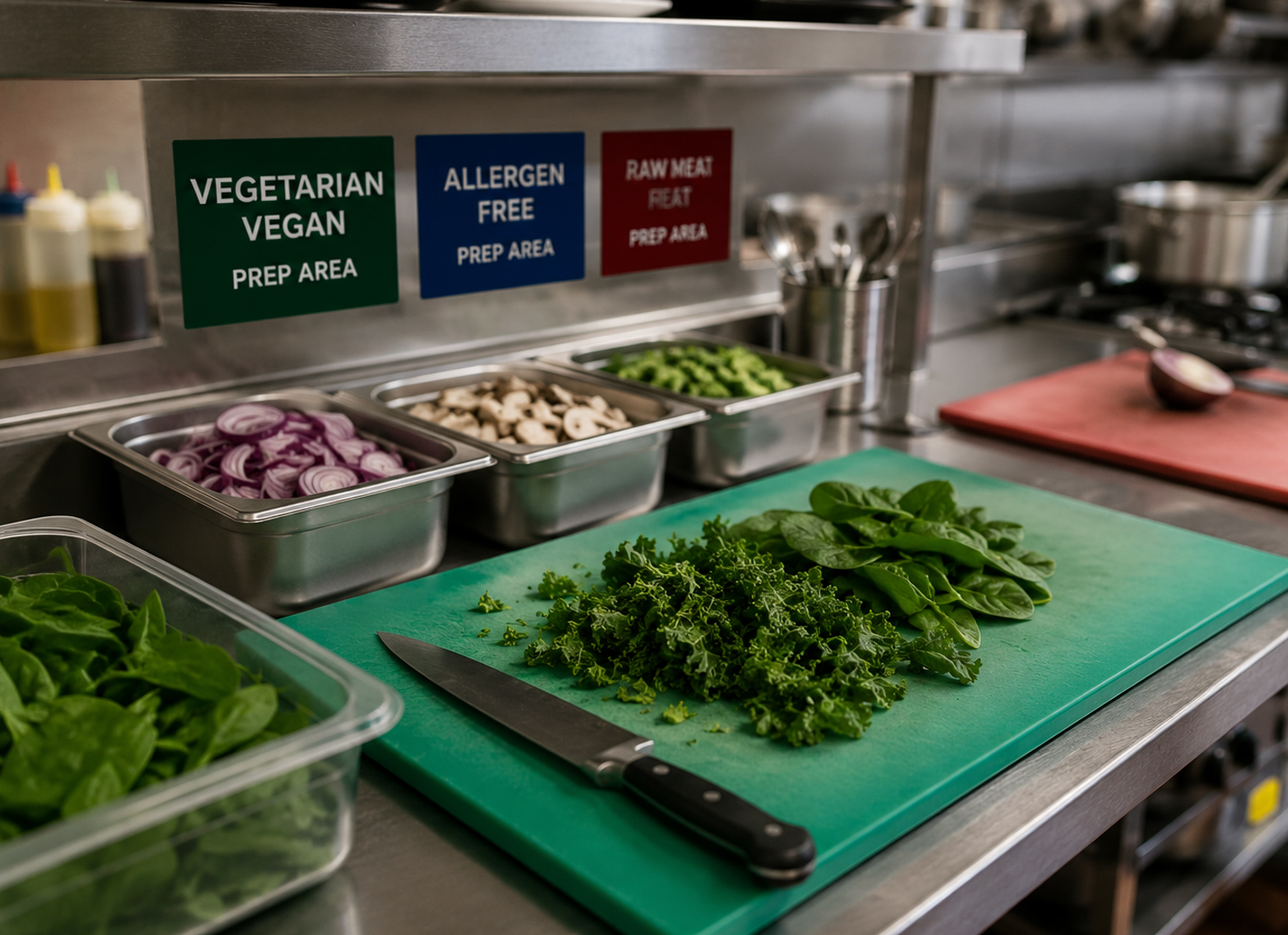
Cross-contamination — what it means and why it matters
Cross-contamination occurs when vegetarian or vegan food comes into contact with meat, fish or their derivatives — whether through shared surfaces, utensils, oil, cooking water, or handling. It is not acceptable.
For some guests this is a matter of personal preference. For others it is a deeply held ethical or religious principle. Either way, once contamination has occurred, the dish is no longer what it was described as on the menu.
A utensil that has touched meat is not a clean utensil, regardless of how briefly it was used.
Separation in the kitchen
- Use separate chopping boards for vegetarian and non-vegetarian preparation. Colour-coding is the simplest system — and it works.
- Keep separate utensils clearly identified. Different-coloured handles, separate storage, or clear labelling all work well.
- Wash hands after handling meat, fish or poultry before touching vegetarian ingredients or equipment.
- Use separate cleaning cloths, tea towels and washing-up equipment for vegetarian preparation areas.
- Where possible, section off a dedicated vegetarian preparation area in the kitchen, even if it is small.
- Change oil between frying vegetarian and non-vegetarian items. Oil that has been used for fish or meat is not suitable for vegetarian dishes.
Serving
- Use separate serving utensils for each dish. A spoon or pair of tongs that has been used on a meat dish should not go near a vegetarian dish.
- This applies equally when dishes are served buffet-style or as shared plates. Guests sharing a table with meat-eaters should not have to ask others to use separate utensils — the arrangement should make it natural.
- Change greaseproof paper or lining when using shared grills or sandwich presses between vegetarian and non-vegetarian items.
- Keep vegetarian and vegan dishes covered and clearly separate during service, particularly at buffets or shared-plate settings.
Storage
- Store vegetarian and vegan ingredients separately from meat, fish and poultry — above them in the fridge if separate storage is not possible, to prevent drip contamination.
- Label stored ingredients and prepared dishes clearly.
- Keep a separate section of the fridge or cold store for vegetarian and vegan preparation where possible.
Packaging and takeaway
Vegetarian and vegan items should be packaged separately from non-vegetarian items. If they go into the same bag, the packaging itself becomes the issue — not the food.
It is worth knowing that some packaging materials contain animal-derived components in their adhesives, dyes or coatings. This is a niche area, but worth raising with your packaging supplier if you are aiming for full vegetarian or vegan compliance.
The most important step
The most common failure point is not the kitchen — it is the front of house. A vegetarian dish prepared perfectly can still result in a poor experience if the person at the table cannot confidently answer a question about it.
Brief your front-of-house team regularly, especially when menus change. Make sure they know which dishes are vegetarian and vegan, what the key ingredients are, and what to say when they are not sure. “I’ll check for you” is a perfectly good answer. “I think it should be fine” is not.

Found this useful?
We can look at how your specific venue is doing.