
Good menu labelling is one of the most straightforward things a venue can do — and one of the most appreciated. For vegetarian and vegan guests, being able to navigate a menu without having to ask about every dish is a significant part of a positive experience.
Guidance
What goes on the menu — and how
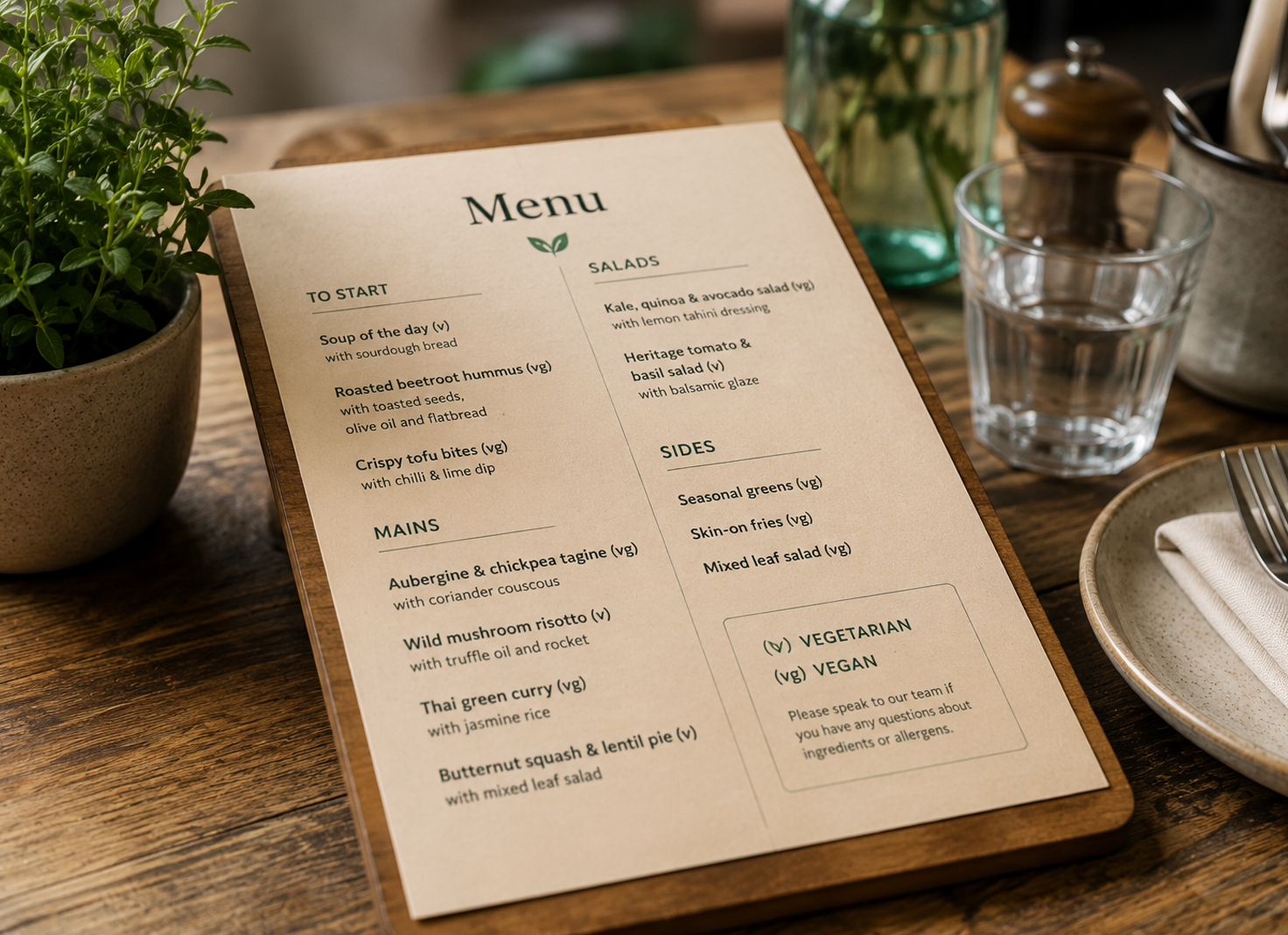
Keep it consistent
Whatever system you use — symbols, coloured text, letters, icons — apply it consistently throughout the entire menu. A guest who has learned that a leaf symbol means vegetarian on page one of the menu should not have to second-guess it on page three.
If your menu is updated seasonally, make sure the labelling is updated with it. An out-of-date label is worse than no label at all.
The standard symbols
There is no single legally mandated symbol for vegetarian or vegan dishes in the UK. However, the following are widely understood and a sensible choice:
- V — vegetarian (no meat, fish or poultry)
- VE or Ve — vegan (no animal-derived ingredients of any kind)
- PB — plant-based (note: this term has no standard legal definition — use with care)
Always include a key on the menu explaining what each symbol means. Do not assume guests will know.
What vegetarian and vegan mean on your menu
There is no single legal definition of “vegetarian” or “vegan” in UK law. This means that when you use the term on your menu, you are making an implicit commitment to your guests based on their reasonable expectations.
A guest who orders a dish described as vegetarian reasonably expects it to contain no meat, poultry, fish or slaughterhouse by-products, and to have been prepared without cross-contamination.
A guest who orders a dish described as vegan additionally expects it to contain no dairy, eggs, honey or other animal-derived ingredients.
If a dish meets most but not all of these criteria, it should not be described as vegetarian or vegan. Describe it accurately, or add a note explaining what it does contain.
The grey areas worth noting
- Cheese — some hard cheeses use animal rennet. If your cheese is made with animal rennet, a dish containing it is not suitable for strict vegetarians. Confirm with your supplier.
- Parmesan — traditional Parmigiano-Reggiano is made with animal rennet. If you use a vegetarian alternative, say so. If you use the real thing, do not label the dish vegetarian.
- Pasta — fresh pasta typically contains egg. This makes it vegetarian but not vegan.
- Sauces and stocks — many commercial sauces and stocks contain meat or fish derivatives. Always check.
- Bread — some breads contain E471 or other emulsifiers that may be animal-derived. If you are unsure, ask your baker or check the specification sheet.
If in doubt, say so
If you are not certain whether a dish meets vegetarian or vegan criteria — because a supplier hasn’t confirmed an ingredient, for example — do not label it and do not guess. A note such as “may contain dairy” or “please ask a member of staff” is honest and useful. Silence is not.
“Suitable for vegetarians” is a commitment, not a guess. Only use it when you know it to be true.
Legal context
Under the Food Information Regulations 2014, food descriptions must be accurate and not misleading. This applies to menus as well as packaging. Describing a dish as vegetarian when it is not — whether through incorrect labelling or undisclosed ingredients — is a criminal offence.
The Food Standards Agency provides free online allergen and labelling training for food businesses. See https://allergytraining.food.gov.uk/ for details.

Found this useful?
We can look at how your specific venue is doing.